Image via Steven Worthy
Courtesy of Rob Knox, Howard Athletics Consultant
The air above the white steel-truss Edmund Pettus Bridge is quiet, but it carries a weight, as if each breeze were whispering the names of people who once walked this road with nothing but courage to protect them, their bodies bruised, bloodied and still moving forward.
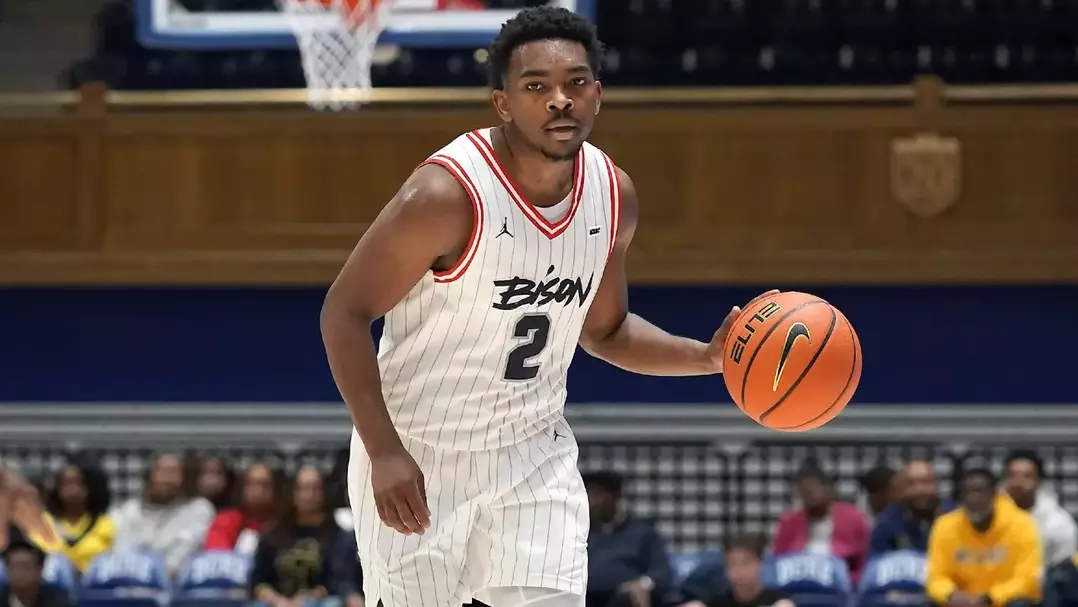
Cam Gillus (Falls Church, Va.) felt the ground beneath him holding memories of fear and hope and his own footsteps suddenly felt small, almost reverent. The Howard University men’s basketball junior point guard knew he was standing in history, stepping into a heartbeat that was not his own but somehow lived in his chest.
As one of more than 150 student-athletes and administrators who participated in the Big Life Series: Selma to Montgomery, sponsored by the Big Ten Conference from July 18-20, Gillus experienced a profound connection to history. The delegation included representatives from all 18 Big Ten universities, along with Historically Black Colleges and Universities (HBCUs) Alabama State, Florida A&M, Howard and North Carolina A&T State (NCAT). Also representing Howard was volleyball standout Kaitlynn Robinson(Oklahoma City).
“My biggest takeaway was just realizing the pain and struggle Black people had to go through and how far we have come to make life better for us,” Gillus said of his walk across the historic bridge. “The most meaningful part was hearing the stories and being on the historical sites we visited, like the Edmund Pettus Bridge, where Bloody Sunday occurred. It was very powerful and eye-opening to experience these things.”
Experiences like this are at the heart of the Big Life Series, which aims to inspire student-athletes to see leadership as a calling shaped by empathy, awareness and action. Gillus walked away with a clearer understanding that the story of Selma is not frozen in time. It is a living reminder of what courage looks like and what it demands, reinforcing the importance of personal growth and legacy.
Walking across the bridge felt like history pressing a hand to Gillus’ shoulder, asking him to remember and urging him to carry something forward.
Opportunities like those do more than deepen perspective, they shape how someone carries themselves when the lights come on and the ball is in their hands.
And in that way, what he felt in Selma mirrors the path in front of him now. Just as generations before him paved the way, Gillus is learning that he, too, has a responsibility to lead, to steady others and to leave something behind for the ones coming after him. Legacy is not only held in monuments and bridges. It is held in people.
FLOOR GENERAL
The first thing you notice about Gillus is not his handle or his pace or even the steadiness that comes with being a natural floor general. It is the calm, the centeredness, the sense that he knows exactly who he is and why he is here.
Gillus grew up in Falls Church, Virginia, splitting his formative years between the DMV and Sidwell Friends School in northwest D.C. The District shaped him long before college basketball did. The culture, the pride, the pace, the way people carry themselves—it all seeped into him. So, when the chance came to transfer from Lehigh University back to this familiar orbit, Howard felt less like a decision and more like a reflection of his roots.
“Being closer to home has definitely been something I appreciate,” Gillus said. “Just being around family again and then getting acclimated to Howard—its culture, its people, its energy—it has been a pretty smooth transition.”
Smooth, yes. Simple, no.
Because Gillus is not just any new arrival, he is a point guard-a role that demands leadership and quick decision-making. And point guards do not get to ease into anything.
They set the room’s temperature.
They fix the rhythm when it is off.
They absorb the pressure so everyone else can breathe.
And that burden—light for some, crushing for others—feels natural to him.
THE MAKING OF A POINT GUARD
Point guards, like marchers, are defined by action.
Gillus laughs a little when he talks about it: the small kid, ball too big for his hands, trying to be heard among bigger bodies. Ball-handling, passing, knowing where everyone was supposed to be—those were survival tools. But intelligence was the separator.
“Growing up, I was always one of the smaller dudes,” he said. “I had to learn how to see the game differently. I always felt like I was one of the most intelligent players on the court. That is what helped me thrive as a point guard.”
Two men helped him mold that gift: his father, Darren Gillus, who built the foundation and coach Eric Singletary at Sidwell Friends, who took him from good to polished. Singletary’s mentorship exemplifies how guidance shapes future leaders and that lineage of influence mattered.
“He really helped me take my game to the next level,” Gillus said. “He poured all his knowledge into me.”
Yet, the impact ran deeper than bounce passes and ball screens. Gillus talks about his father with the kind of reverence you usually hear in eulogies or wedding toasts. A quiet giant. A steady presence. A compass.
“He is had the biggest impact on me,” Gillus said. “Basketball or not, he has always been someone I can go to for advice. He wants me to be the best version of myself.”
LEAVING, LEARNING, RETURNING
At Lehigh, Gillus became a college basketball player.
Not in theory. In reality.
He played meaningful minutes as a freshman and sophomore, learned how to run a team, manage moments and led men older and stronger than him. He earned a Patriot League–level education and the kind of lived experience that stays with you long after the sneakers stop squeaking.
Leaving was not a rejection of that. It was a return to something more personal.
At Howard, Gillus found something few players get to experience: the best of both worlds. A world-class education. A basketball program with ambition and Jordan-branded gear. And a campus full of people who look like him—strivers, dreamers, innovators, hustlers, each driven by purpose and potential.
“Seeing so many people who want to excel, who want to be great in life—that pushes you,” he said. “Being around that every day motivates you to do more.”
Through 14 starts this season for the Bison, Gillus is averaging 11.2 points and scored a season-high 19 points in a neutral site win over NCAT (Dec. 9). Gillus has scored in double figures nine times this season, including the last six outings.
As a point guard supreme, Gillus brings the ball up the floor, his eyes move like he is using a jeweler’s loupe to scan the defense, searching for the slightest crack. He is averaging 4.0 assists per game and has had seven games with at least five assists, including a season-high six on four different occasions.
Last season at Lehigh, Gillus started 29 games and led the team with 37 total steals. He scored in double-figures 12 times, including 21 points against Georgetown (Nov. 6) and a season-high 25 points against Loyola (Jan. 5). Gillus also posted his first career double-double against Holy Cross (Feb. 1) with 16 points and 10 rebounds.
THE WHY BEHIND THE WORK
Every athlete has a “why.” Gillus used to be simple—because basketball was fun, because it stuck, because the hoop in the driveway pulled him in like gravity.
But now, his “why” has a name.
Caleb.
His little brother.
“Seeing him watch me and try to do what I do—it pushes me,” Gillus said. “He’s my why.”
The universality of that moment—an older brother becoming a blueprint—anchors the entire story. You can see the lineage. A father poured into him. A coach molded him. Now, he pours into Caleb. One generation sharpening the next.
That is the same continuum he stepped into on the Edmund Pettus Bridge. Different setting, same truth. What we inherit shapes us and what we give back becomes someone else’s beginning.
That is bigger than basketball. Bigger than Howard. Bigger than the DMV.
That is legacy.
WHAT’S NEXT
Gillus is nowhere near done. On the court, he sees a Howard team with talent, depth and selflessness, “a solid foundation,” as he calls it. Off the court, he is an economics major with a minor in sports administration, dreaming of someday becoming an NBA general manager (GM). It fits him. GMs lead. GMs see the game differently. GMs make everyone around them better.
Just like point guards.
Just like the kid from Falls Church who came home and found something more profound than a system or a scheme—he found purpose.
The marchers of Selma showed the world what it means to keep moving, even when the path is steep and the world pushes back. Gillus carries that same spirit with him. Every possession, every practice, every moment of leadership becomes its own small march forward.
The setting is different, but the truth remains. Legacy is continued by those who refuse to stand still.
Rob Knox is an award-winning professional and a member of the Lincoln (Pa.) Athletics Hall of Fame. In addition to having work published in SLAM magazine, the Philadelphia Inquirer, the Washington Post, and Diverse Issues In Higher Education, Knox enjoyed a distinguished career as an athletics communicator for Lincoln, Kutztown, Coppin State, Towson, and UNC Greensboro. He also worked at ESPN and for the Delaware County Daily Times. Recently, Knox was honored by CSC with the Mary Jo Haverbeck Trailblazer Award and the NCAA with its Champion of Diversity award. Named a HBCU Legend by SI.com, Knox is a graduate of Lincoln University and a past president of the College Sports Communicators, formerly CoSIDA.